
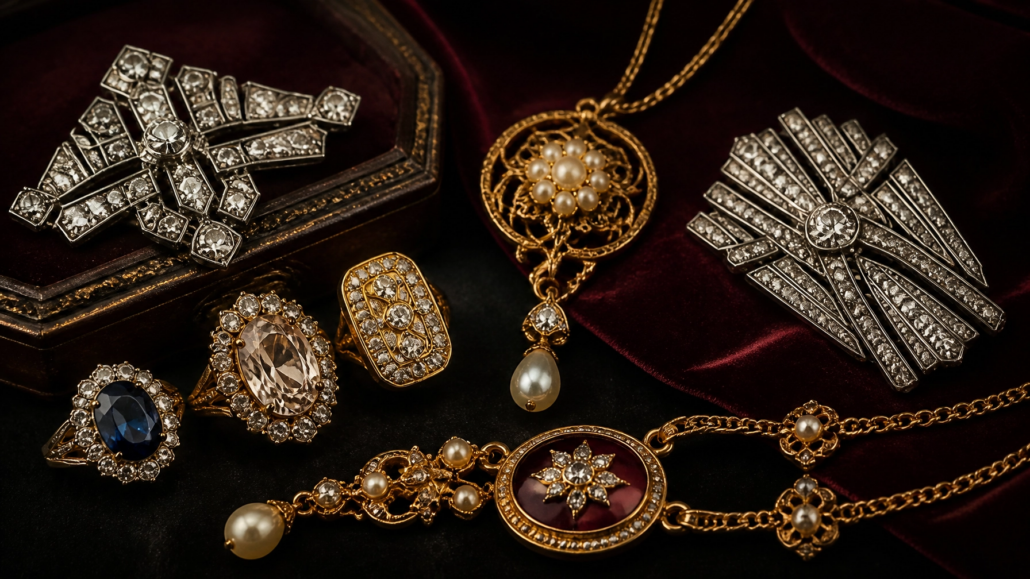
Estate Jewelry 101: A Beginner’s Guide to Mastering Eras from Victorian to Art Deco
Estate Jewelry Definition
Estate jewelry refers to previously owned items of jewelry. The category includes vintage jewelry and antique jewelry. Antique jewelry must exceed 100 years of age. Vintage jewelry refers to items between 20 and 100 years of age. Identification of eras requires analysis of materials. Identification of eras requires analysis of construction techniques. Identification of eras requires analysis of motifs.
Blair House Antiques maintains an inventory of estate jewelry in Knoxville TN. The collection includes items from multiple historical periods. Expert collectors source items for the antique store knoxville tn.
Georgian Era Data 1714-1837
The Georgian era covers the reigns of King George I through King George IV.
- Period date range: 1714 to 1837.
- Metal primary: Silver.
- Metal secondary: Yellow gold.
- Metal combination: Silver-topped gold.
- Setting type: Closed-back.
- Setting type: Foil-backed.
- Stone cut: Rose cut.
- Stone cut: Mine cut.
- Stone cut: Table cut.
- Motif: Floral.
- Motif: Bows.
- Motif: Feathers.
- Construction: Handmade.
- Construction: Irregular.
Georgian items exhibit high rarity. Hand-fabrication is the manufacturing standard. Solder marks are visible under magnification. Foil backing increases stone reflection. Liquid contact degrades foil backing.
Victorian Era Data 1837-1901
The Victorian era corresponds to the reign of Queen Victoria. The period divides into Early, Mid, and Late stages.

- Period date range: 1837 to 1901.
- Early stage: 1837 to 1860.
- Mid stage: 1860 to 1885.
- Late stage: 1885 to 1901.
- Metal: 10k gold.
- Metal: 14k gold.
- Metal: 18k gold.
- Metal: Silver.
- Stone: Garnet.
- Stone: Amethyst.
- Stone: Turquoise.
- Stone: Seed pearls.
- Stone: Diamond.
- Motif: Snakes.
- Motif: Hearts.
- Motif: Hands.
- Motif: Anchors.
- Motif: Flowers.
- Clasp type: C-clasp.
Victorian jewelry utilizes symbolic motifs. Early Victorian pieces prioritize romanticism. Mid-Victorian pieces prioritize mourning jewelry. Mourning jewelry uses jet. Mourning jewelry uses onyx. Late Victorian pieces prioritize mass production. Gold discovery in California increased metal availability. Gold discovery in Australia increased metal availability. Hallmark identification is necessary for dating. Access estate jewelry knoxville tn for era specifics.
Edwardian Era Data 1901-1915
The Edwardian era corresponds to the reign of King Edward VII.
- Period date range: 1901 to 1915.
- Metal primary: Platinum.
- Metal secondary: White gold.
- Design style: Filigree.
- Design style: Milgrain.
- Motif: Garlands.
- Motif: Ribbons.
- Motif: Wreaths.
- Motif: Bows.
- Stone: Diamond.
- Stone: Pearl.
- Color profile: White on white.
- Construction: Delicate.
- Construction: Lace-like.
Edwardian jewelry uses platinum for structural strength. High strength allows thin metal lines. Filigree consists of soldered metal threads. Milgrain consists of beaded metal edges. Jewelry from this period exhibits lightweight characteristics. Garlands are common decorative elements. Pearls are common primary stones. Diamonds provide secondary brilliance.
Art Deco Era Data 1920-1939
The Art Deco era follows World War I. The period emphasizes industrialization and geometry.

- Period date range: 1920 to 1939.
- Metal primary: Platinum.
- Metal secondary: White gold.
- Style: Geometric.
- Style: Symmetrical.
- Style: Linear.
- Stone: Sapphire.
- Stone: Ruby.
- Stone: Emerald.
- Stone: Onyx.
- Stone: Diamond.
- Stone cut: Emerald cut.
- Stone cut: Baguette.
- Stone cut: Calibré.
- Motif: Skyscrapers.
- Motif: Sunbursts.
- Motif: Egyptian.
Art Deco jewelry uses high-contrast colors. Black onyx contrasts with white diamonds. Rubies contrast with platinum. Symmetry is a mandatory design requirement. Calibré-cut stones fit together without gaps. Emerald cuts emphasize vertical lines. Synthetic sapphires are common in this period. White gold became a standard substitute for platinum. Vintage jewelry knoxville tn inventory contains these items.
Maintenance Protocols
Proper maintenance preserves item value. Proper maintenance prevents structural failure.

- Tool: Soft cloth.
- Tool: Soft brush.
- Agent: Mild soap.
- Agent: Warm water.
- Protocol: Surface wipe.
- Protocol: Dry storage.
- Protocol: Separate storage.
- Warning: No ultrasonic cleaning.
- Warning: No steam cleaning.
- Warning: No chemical exposure.
- Warning: No immersion for foil-backs.
Porosity affects pearls. Porosity affects turquoise. Chemicals damage organic stones. Ultrasonic vibrations loosen stones. Steam heat expands metals. Expansion causes stone cracks. Foil-backed items require dry cleaning only. Silver tarnishes in humid environments. Gold requires minimal cleaning. Platinum maintains color stability. Periodic inspection of prongs is a technical requirement.
Knoxville Location Data
Blair House Antiques operates in a historic building. The building construction date is 1920. The location is 210 N Forest Park Blvd, Knoxville TN.

- Facility type: Historic 1920s building.
- Service: Antique sourcing.
- Service: Jewelry curation.
- Inventory: Estate jewelry.
- Inventory: Sterling silver.
- Inventory: Antique chandeliers.
- Inventory: Gemstone jewelry.
- Geography: Knoxville TN.
- Neighborhood: Bearden.
The facility provides a specific environment for collectors. Expert collectors curate the inventory. Selection includes high-value estate rings. Selection includes vintage gifts. The facility accommodates multiple budgets. The building history includes use as a restaurant. The building history includes use as a florist. The current operation began in 1985. The ownership is professional.
Technical Analysis of Stone Cuts
Stone cuts determine the era of the jewelry item.
- Rose Cut: Flat base. Triangular facets. Used in Georgian era. Used in Victorian era.
- Old Mine Cut: Squarish shape. High crown. Small table. Used in 18th century. Used in 19th century.
- Old European Cut: Circular shape. Large facets. Used in Victorian era. Used in Edwardian era.
- Transitional Cut: Evolution toward modern brilliant. Used in 1920s. Used in 1930s.
- Emerald Cut: Step cut. Rectangular. Used in Art Deco era.
- Baguette Cut: Rectangular. Step cut. Used for accent stones. Used in Art Deco era.
Analysis of facets indicates the manufacturing date. Hand-cut stones exhibit asymmetry. Machine-cut stones exhibit high symmetry. Facet count increases over time. Brilliance increases over time. Identification of cuts facilitates era classification.
Metal Fineness Specifications
Identification of metal markings is a technical requirement.
- Marking: 10k. Gold content: 41.7%.
- Marking: 14k. Gold content: 58.5%.
- Marking: 18k. Gold content: 75%.
- Marking: PLAT. Platinum content: 95%.
- Marking: 925. Silver content: 92.5%.
- Marking: STERLING. Silver content: 92.5%.
- Hallmark: British assay mark. Indicates location. Indicates date.
- Maker's Mark: Identifies the manufacturer.
Hallmarks appear on the interior of rings. Hallmarks appear on the clasp of necklaces. Hallmarks appear on the back of brooches. Verification of markings ensures authenticity. Eras use specific gold alloys. Rose gold is common in Victorian jewelry. White gold is common after 1915. Platinum usage is dominant in Art Deco.
System Summary
The collection of estate jewelry requires knowledge of history. The collection of estate jewelry requires knowledge of materials. Identification focuses on Georgian, Victorian, Edwardian, and Art Deco eras. Maintenance requires specific protocols to avoid damage. Blair House Antiques provides access to these items in Knoxville TN. The 1920s building serves as the central point for inventory.

