
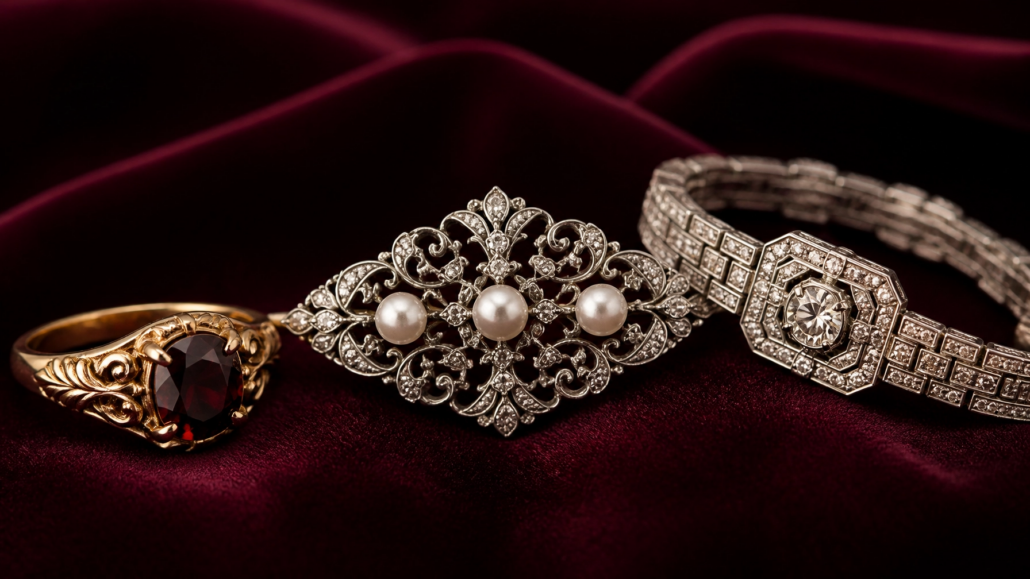
How to Choose the Best Estate Jewelry in Knoxville (A Comparison of the Victorian, Edwardian, and Art Deco Eras)
Identification of Estate Jewelry Eras
Estate jewelry categorization depends on production dates. Antique status requires a minimum age of 100 years. Vintage status requires a minimum age of 20 years. Collectors in Knoxville TN locate these items through specific identification criteria. The primary eras for inventory at Blair House Antiques include the Victorian, Edwardian, and Art Deco periods. Each era utilizes distinct metals. Each era utilizes distinct gemstone cuts. Each era utilizes distinct construction methods.
Estate jewelry Knoxville TN requires technical assessment for valuation. Collectors must verify hallmarks. Collectors must verify stone settings. Collectors must verify metal purity.
The Victorian Era (1837–1901)

The Victorian era correlates with the reign of Queen Victoria. Production spans from 1837 to 1901. Metal usage consists primarily of yellow gold. Metal usage consists primarily of rose gold. Gold purity levels vary between 9k, 12k, 14k, and 18k. Silver is also utilized. Silver is often used for diamond settings. This prevents metal color interference.
Victorian Technical Specifications
Victorian jewelry motifs include snakes. Victorian jewelry motifs include hearts. Victorian jewelry motifs include flowers. Victorian jewelry motifs include birds. Late Victorian pieces include mourning symbols. Mourning symbols include black enamel. Mourning symbols include jet. Mourning symbols include human hair.
Gemstone cuts in this era are hand-cut. Diamonds utilize the old mine cut. The old mine cut features a high crown. The old mine cut features a deep pavilion. The old mine cut features a large culet. This cut optimizes light under candlelight. Other gemstones include garnets. Other gemstones include amethysts. Other gemstones include turquoise. Other gemstones include seed pearls.
Settings often feature closed backs. Closed backs protect foil-lined stones. Foil-lined stones increase light reflection. Water exposure destroys the foil layer. Repairing foil-lined stones requires specialist skills.
The Edwardian Era (1901–1915)

The Edwardian era correlates with the reign of King Edward VII. Production spans from 1901 to 1915. Platinum usage characterizes this era. Platinum provides high structural strength. Platinum allows for thin metal wires. These wires create filigree patterns. These wires create lace patterns.
Edwardian Technical Specifications
Edwardian motifs include bows. Edwardian motifs include garlands. Edwardian motifs include ribbons. Edwardian motifs include wreaths. The design focus is monochromatic. The design focus utilizes white metals. The design focus utilizes white diamonds. The design focus utilizes natural pearls.
Diamonds in this era utilize the old European cut. The old European cut features a round girdle. The old European cut features a small table. The old European cut features 58 facets.
Technical methods include milgrain. Milgrain consists of tiny metal beads. Milgrain borders the edges of settings. Technical methods include knife-edge settings. Knife-edge settings minimize visible metal. This increases the visual prominence of gemstones.
Vintage jewelry Knoxville TN buyers identify Edwardian pieces by these platinum characteristics. The metal density is high. The metal color is neutral.
The Art Deco Era (1920–1935)

The Art Deco era spans from 1920 to 1935. Design focuses on symmetry. Design focuses on geometric shapes. Shapes include triangles. Shapes include squares. Shapes include rectangles. Shapes include circles.
Art Deco Technical Specifications
Metals include platinum. Metals include white gold. White gold became a platinum substitute after World War I. White gold consists of gold alloyed with nickel. White gold consists of gold alloyed with palladium.
Gemstone cuts include step cuts. Step cuts include Asscher cuts. Step cuts include emerald cuts. These cuts feature rectangular facets. These cuts emphasize clarity. The era utilizes high-contrast colors. Diamonds pair with black onyx. Diamonds pair with blue sapphires. Diamonds pair with red rubies. Diamonds pair with green emeralds.
Calibré cuts are common. Calibré stones are custom-cut. Calibré stones fit into geometric channels. Calibré stones lack gaps between stones. This creates a solid color surface.
Technical Comparison of Eras
| Feature | Victorian Era | Edwardian Era | Art Deco Era |
|---|---|---|---|
| Dates | 1837–1901 | 1901–1915 | 1920–1935 |
| Metals | Yellow/Rose Gold | Platinum | Platinum/White Gold |
| Primary Cut | Old Mine Cut | Old European Cut | Step/Emerald Cut |
| Patterns | Naturalistic | Filigree/Lace | Geometric/Symmetric |
| Color Profile | Warm/Gold | Monochromatic/White | High Contrast/Bold |
Maintenance Protocols for Estate Jewelry

Antique items require specific maintenance cycles. Owners must execute cleaning procedures. Owners must execute storage procedures.
Cleaning Procedures
- Inspect the item with a 10x jeweler’s loupe.
- Confirm stone stability.
- Utilize lukewarm water.
- Utilize mild soap.
- Utilize a soft-bristled brush.
- Rinse the item.
- Dry the item with a lint-free cloth.
Caring for antique jewelry prohibits ultrasonic cleaners for specific items. Ultrasonic cleaners damage pearls. Ultrasonic cleaners damage opals. Ultrasonic cleaners damage emeralds. Ultrasonic cleaners damage foil-backed stones. Steam cleaners damage organic materials.
Storage Procedures
Store items in individual pouches. Individual pouches prevent contact. Individual pouches prevent scratches. Diamonds scratch gold. Diamonds scratch platinum. Diamonds scratch other gemstones. Maintain a stable climate. High humidity oxidizes silver. High heat dehydrates opals. High heat dehydrates pearls.
Sourcing Estate Jewelry in Knoxville TN

Blair House Antiques operates in a historic 1920s building. This antique store Knoxville TN maintains an inventory of estate jewelry. The inventory includes Victorian pieces. The inventory includes Edwardian pieces. The inventory includes Art Deco pieces.
Expert collectors source the inventory. The selection process prioritizes authenticity. The selection process prioritizes condition. The selection process prioritizes historical accuracy.
Checklist for Knoxville Collectors
- Verify metal hallmarks on the interior of the band.
- Inspect the girdle of the diamond for laser inscriptions or chips.
- Examine the prongs for wear.
- Examine the hinges for mechanical failure.
- Request documentation of provenance.
- Request documentation of gemological reports.
Collectors must visit the location to inspect physical items. The physical inventory changes. New acquisitions arrive frequently. Regular inspections ensure the acquisition of high-value items.
Blair House Antiques provides sterling silver jewelry. Blair House Antiques provides gemstone jewelry. Blair House Antiques provides antique chandeliers. Each item undergoes technical verification. Each item is cleaned. Each item is cataloged.
The procurement of estate jewelry requires technical knowledge. This guide provides the technical foundation for the Victorian, Edwardian, and Art Deco eras. Follow the maintenance protocols to preserve item value. Visit Blair House Antiques in Knoxville for procurement requirements.
