
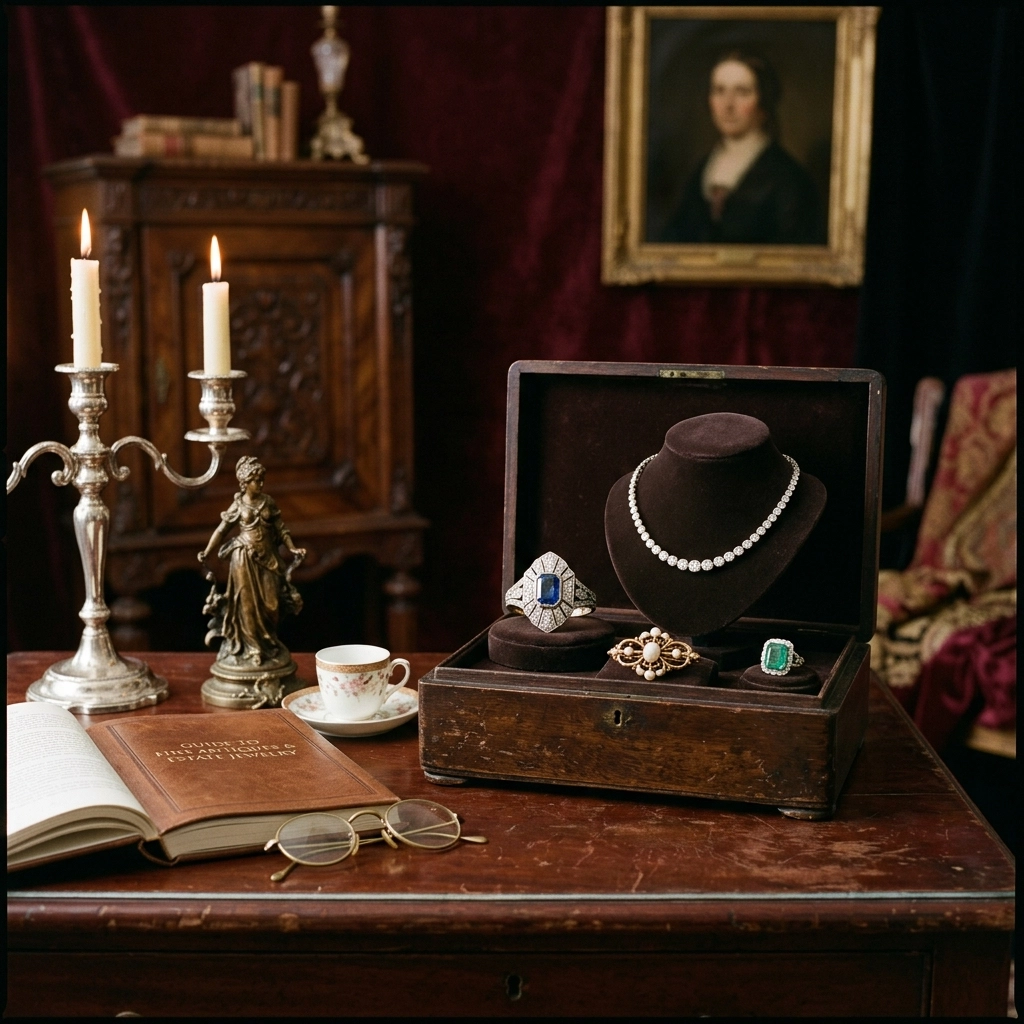
The History, Care, and Collection of Rare Estate Jewelry and Antiques
To collect rare estate jewelry and fine antiques is to preserve more than beauty. Each piece carries the imprint of a particular age: the social customs of its time, the hands that fashioned it, and the people who wore, used, or cherished it before it reached your collection.
At Blair House Antiques, we believe the pleasure of collecting lies in this conversation between past and present. Our historic 1920s building in Knoxville provides an atmosphere worthy of such objects: quiet rooms, period architecture, and carefully sourced treasures that invite close examination. Whether you are searching for an heirloom diamond ring, a Victorian brooch, a sterling silver service, or an antique chandelier, understanding an object’s history is the first step toward becoming its thoughtful custodian.
A Brief History of Antique Jewelry
Antique jewelry is generally understood to be at least 100 years old, while “estate jewelry” describes previously owned jewelry of many different ages. A Georgian ring, an Edwardian necklace, and an Art Deco bracelet may all be estate jewelry, but each belongs to a distinct design language shaped by its era.
Learning to recognize these periods helps collectors assess craftsmanship, authenticity, condition, and care requirements.
Georgian Jewelry: Handcrafted Romance and Rare Materials
The Georgian era, spanning approximately 1714 to 1837, predates modern mass production. Jewelry was made largely by hand, and surviving examples are consequently scarce. Their construction often reveals the individuality of the maker: irregularly shaped stones, hand-cut diamonds, and settings with subtle variations that would be unlikely in a later machine-assisted piece.
Georgian jewels frequently feature silver-topped settings, high-karat yellow gold, rose-cut or table-cut diamonds, garnets, topaz, and other colored stones. Many gemstones were foil-backed, meaning a thin layer of reflective foil was placed behind the stone to intensify its appearance in candlelight. Common motifs included flowers, leaves, feathers, ribbons, bows, and classical ornament.
The delicacy of Georgian construction is part of its allure: and one reason these pieces require exceptional care. Moisture can penetrate closed-back settings and damage the foil, causing discoloration or clouding. A genuine Georgian jewel should never be treated as ordinary modern jewelry. It is better understood as a small historical artifact.

Victorian Jewelry: Sentiment, Symbolism, and Variety
Victorian jewelry reflects the long reign of Queen Victoria, from 1837 to 1901. Because the period lasted so many decades, its styles are remarkably diverse. Collectors often discuss Victorian jewelry in three broad phases: Romantic, Grand, and Aesthetic.
Early Victorian or Romantic jewelry favored sentimental motifs. Serpents symbolized eternal love, while hearts, flowers, bows, and clasped hands conveyed devotion and affection. Gold, seed pearls, turquoise, and colorful gemstones were common.
Following the death of Prince Albert in 1861, mourning jewelry became especially influential. Jet, onyx, black enamel, bog oak, and woven hair appeared in pieces designed to commemorate the deceased. These jewels can be emotionally powerful, combining personal remembrance with elaborate craftsmanship.
Later Victorian jewelry became lighter and more eclectic. Nature, archaeological discoveries, and international influences shaped design, while advances in mining and manufacturing made diamonds more widely available. Old Mine and Old European cuts: both characterized by softer, more individual faceting than modern brilliant cuts: remain highly prized for their warm, lively scintillation.
When collecting Victorian jewelry, look closely at symbolism, construction, and condition. A piece’s original materials and honest wear can be more meaningful than an overly polished restoration.
Edwardian Jewelry: Platinum, Filigree, and Belle Époque Elegance
The Edwardian era, generally dated from 1901 to 1915, introduced an ethereal lightness to jewelry design. Named for the reign of King Edward VII, the period is also associated with the Belle Époque, an age of refinement, international travel, and lavish social occasions.
Platinum transformed jewelry making. Stronger than gold, platinum allowed artisans to create remarkably fine openwork, filigree, and millegrain detailing. The result was jewelry that appeared almost weightless: lace-like garlands, bows, ribbons, tassels, crescents, wreaths, and delicate floral sprays.
Diamonds and pearls dominated the Edwardian palette, often producing the period’s characteristic all-white appearance. Old European-cut diamonds, with their high crowns and broad facets, offer a gentle glow rather than the sharp flash of a contemporary brilliant cut.
Edwardian filigree is structurally fine, even when crafted from durable platinum. Before wearing an Edwardian jewel, inspect the openwork for distortion, cracks, or missing wires. Resizing and repairs should be entrusted to a jeweler familiar with antique platinum, as careless work may compromise the original design.
Art Deco Jewelry: Geometry and Modern Glamour
Art Deco jewelry emerged after the First World War and reached its height during the 1920s and 1930s. In contrast to the flowing ornament of earlier periods, Art Deco embraced geometry, symmetry, clean lines, and bold contrast.
Platinum and white gold were favored, often set with diamonds, calibré-cut sapphires, emeralds, rubies, or onyx. Calibré stones were custom-cut to fit a particular design, creating precise borders and uninterrupted fields of color. Baguette, emerald, triangle, and marquise cuts reinforced the architecture of the pieces.
Art Deco designers drew inspiration from Cubism, industrial machinery, ancient Egypt, and modern architecture. Long sautoir necklaces, wide bracelets, geometric rings, and dress clips reflected the confidence and movement of the Jazz Age.
For further study, collectors may enjoy this overview of Art Deco jewelry from Lang Antiques. When assessing an Art Deco piece, pay attention to crisp geometry, balanced proportions, quality of stone setting, and whether the original materials remain intact.

How to Care for Antique and Estate Jewelry
The best care begins with restraint. Antique jewelry should be cleaned according to its materials and construction: not according to a one-size-fits-all routine.
Avoid Moisture and Harsh Chemicals
Remove jewelry before bathing, swimming, exercising, or doing household work. Perfume, hairspray, lotions, chlorine, and cleaning products can dull metal, weaken settings, or damage vulnerable stones.
Georgian foil-backed jewelry should generally not be soaked. Pearls, opals, emeralds, coral, turquoise, enamel, and other porous or treated materials also require special caution.
Be Careful with Ultrasonic Cleaners
Ultrasonic cleaners may loosen old solder joints, fragile stones, or delicate settings. They are particularly unsuitable for antique jewelry with foil-backed stones, pearls, emeralds, opals, enamel, or intricate filigree.
For a piece confirmed to be safe for gentle cleaning, use a soft brush, lukewarm water, and a small amount of mild soap. Never scrub aggressively. Pat the jewel dry with a soft, lint-free cloth and allow moisture to leave the setting completely.
When in doubt, choose professional cleaning over experimentation. Our antique jewelry collection offers an opportunity to examine period construction and discuss appropriate preservation with knowledgeable specialists.
Store Every Piece Separately
Diamonds can scratch softer gemstones and precious metals, while chains and pins can catch on one another. Store each jewel in its own fabric-lined compartment or soft pouch. Avoid bathrooms, attics, basements, and areas exposed to dramatic changes in temperature or humidity.
Keep pearls away from excessive dryness and heat, and protect colored stones from prolonged sunlight when their color may be vulnerable. Photograph significant pieces and maintain notes about their condition, hallmarks, provenance, and any professional work performed.
Schedule Regular Inspections
A professional inspection can identify loose stones, worn prongs, weakened clasps, thin shanks, or damaged hinges before a small issue becomes an irreversible loss. Valuable or frequently worn pieces deserve periodic review, while especially fragile Georgian and Edwardian jewels may be best worn only on appropriate occasions.
Building a Thoughtful Collection in Knoxville
A meaningful collection does not need to begin with the rarest or most expensive object. Begin with the period, motif, or material that genuinely speaks to you. You might collect Victorian sentimental jewels, Edwardian diamond earrings, Art Deco platinum rings, or sterling silver by a particular maker.
As you explore estate jewelry Knoxville TN, consider these questions:
- Does the design exhibit the characteristics of its stated period?
- Are the hallmarks, gemstone cuts, and construction consistent?
- Has the piece been resized, converted, or repaired?
- Are replacement stones disclosed?
- Is the condition appropriate for your intended use?
- Can the dealer provide a written description or available provenance?
A reputable dealer should welcome careful questions. In a curated environment, you can compare periods side by side and develop an educated eye over time.
For Knoxville collectors, Blair House Antiques offers a particularly distinctive setting. Built by Gene and Florence Monday in the 1920s, the building has served as a florist and even a speakeasy before becoming a destination for fine antiques. Its historic character enriches the experience of browsing, while our carefully selected inventory ranges from gemstone jewelry and diamonds to sterling silver, chandeliers, and vintage collectibles.
Whether your search is for vintage jewelry Knoxville TN, a statement piece for an interior, or an authentic gift with a story, the right antique reveals itself through quality, proportion, and feeling. Visit our Knoxville location to explore the collection in person, or browse the Blair House Antiques website before your visit.
Preserving Beauty for the Next Generation
Rare estate jewelry and antiques reward patience. Their value is found not only in age or precious materials, but in the survival of skilled workmanship and human meaning. A Georgian brooch preserves the intimacy of candlelit adornment. A Victorian jewel speaks in symbols of love and remembrance. An Edwardian necklace captures the delicacy of the Belle Époque, while an Art Deco ring expresses the optimism of a modern age.
With informed collecting and thoughtful care, these objects continue their journey. At Blair House Antiques, we are honored to help collectors in Knoxville discover pieces worthy of that journey: treasures to wear, display, give, and eventually pass forward.

