
How to Choose the Best Estate Jewelry in Knoxville TN (Comparing Georgian, Victorian, and Art Deco Eras)
1. Georgian Era Jewelry Specifications (1714-1837)
Georgian jewelry production occurred between 1714 and 1837. Hand-fabrication was the primary method. Silver and gold were the materials. Stones utilized closed-back settings. Foil backing enhanced reflection. Motifs included flora and fauna. Hallmark application was inconsistent.
1.1 Metal Composition and Fabrication
- Gold-purity levels exceeded 18-karat.
- Silver settings held diamonds.
- Silver-topped-gold construction prevented skin discoloration.
- Pinchbeck served as a gold substitute.
- Pinchbeck consists of 83% copper and 17% zinc.
- Iron and steel components appeared in late-period items.
- Cannetille-wirework created filigree patterns.
- Repoussé-techniques involved hammering metal from the reverse side.
1.2 Gemstone and Setting Characteristics
- Diamond-cuts included point, table, rose, and old-mine.
- Foiled-backs increased stone luminescence.
- Closed-back settings protected the foil layer.
- Paste-stones (glass) provided high-quality imitations.
- Colored-stones included garnet, topaz, coral, and chrysoberyl.
- Natural-pearl usage was frequent.
- Stones were often set in clusters.

1.3 Motif Categorization
- Floral-sprays and leaf-patterns.
- Ribbons and bows.
- Birds and insects.
- Feather-plumes (aigrettes).
- Memento-mori jewelry items.
- Multi-purpose-designs (pendant-to-brooch conversions).
2. Victorian Era Jewelry Specifications (1837-1901)
The Victorian era consists of three distinct periods. The Romantic Period spans 1837 to 1860. The Grand Period spans 1861 to 1885. The Aesthetic Period spans 1885 to 1901. Production shifted from manual to industrial methods.
2.1 Romantic Period (1837-1860)
- Sentimentality dictated design.
- Hearts and anchors symbolized love and hope.
- Snakes represented eternal life.
- Gold-standardization occurred in 1854.
- Low-karat gold (9k, 12k, 15k) became legal.
- Acrostic-jewelry used stones to spell words.
2.2 Grand Period (1861-1885)
- Mourning-jewelry followed the death of Prince Albert.
- Jet and onyx were primary materials.
- Black-enamel provided surface decoration.
- Revival-styles included Etruscan and Egyptian.
- Granulation-techniques added surface texture.
- Large-scale-pieces became standard.

2.3 Aesthetic Period (1885-1901)
- Jewelry-scale decreased for daily wear.
- Diamonds moved into open-back settings.
- Claw-settings allowed light penetration.
- Silver-topped-gold usage declined.
- Motifs focused on naturalism and insects.
- Stars and crescent-moons were common.
3. Art Deco Era Jewelry Specifications (1915-1935)
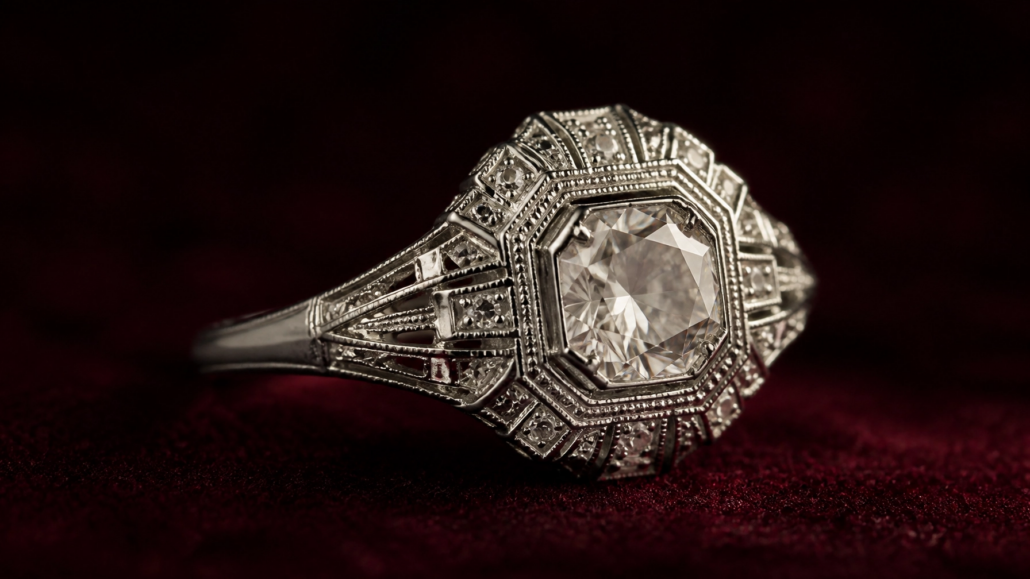
The Art Deco era emphasized geometry and symmetry. Modernization influenced fabrication. Platinum became the preferred metal. Machine-precision defined the aesthetic.
3.1 Material and Metal Systems
- Platinum-usage increased for durability.
- White-gold served as a platinum alternative.
- Diamonds were the primary gemstone focus.
- Old-European cuts preceded modern round-brilliant cuts.
- Baguette and emerald-cuts emphasized linear shapes.
- Chrome and plastic-materials appeared in costume-jewelry.
3.2 Geometric and Color Design
- Symmetry was a requirement.
- Straight-lines and sharp-angles.
- Steps and chevron patterns.
- High-contrast color-combinations.
- Diamonds paired with black-onyx.
- Diamonds paired with red-rubies or green-emeralds.
- Calibre-cut stones fit into precise channels.

3.3 Influences and Forms
- Industrial-design and aerodynamics.
- Egyptian-revival (post-1922).
- Asian-patterns and lacquer-work.
- Long-earrings and cocktail-rings.
- Clip-brooches for lapel-attachment.
- Streamlined-silhouettes.
4. Comparative Analysis of Estate Jewelry Eras
| Feature | Georgian | Victorian | Art Deco |
|---|---|---|---|
| Era Dates | 1714-1837 | 1837-1901 | 1915-1935 |
| Metal Type | Gold, Silver, Pinchbeck | Gold (various karats), Silver, Jet | Platinum, White Gold |
| Stone Setting | Closed-back, Foiled | Transition to Open-back | Open-back, Calibre-cut |
| Design Focus | Ornate, Hand-wrought | Sentimental, Revivalist | Geometric, Symmetrical |
| Standard Cuts | Rose, Table, Old-mine | Old-mine, Old-European | Old-European, Baguette |
5. Selection Process in Knoxville TN
Selecting estate jewelry Knoxville TN requires technical verification. Buyers must identify era-specific markers. Knoxville-based collectors utilize specialized venues. Antique store Knoxville TN locations provide inventory assessment.
5.1 Authenticity Verification Protocols
- Inspect stone-settings for foil-backing (Georgian).
- Examine hallmark-stamps for metal-purity (Victorian).
- Verify symmetry of filigree-work (Art Deco).
- Check for machine-marks on metal-surfaces.
- Assess gemstone-cuts for period-accuracy.
- Identify repair-solder-points.
- Evaluate enamel-integrity.
5.2 Local Marketplace Availability
- Knoxville-market includes dedicated estate-dealers.
- Blair House Antiques maintains a curated inventory.
- Inventory includes vintage jewelry Knoxville TN.
- Categories include rings, brooches, necklaces, and bracelets.
- Sourcing occurs through estate-liquidation and expert-collection.
- Historic-building locations house the inventory.

6. Care and Maintenance Protocols
Estate jewelry requires specific maintenance-schedules. Degradation occurs from environmental-exposure. Chemical-contact must be avoided.
6.1 Cleaning Requirements
- Use soft-brushes for surface-dirt-removal.
- Avoid ultrasonic-cleaners for Georgian-foiled-stones.
- Moisture-exposure destroys foil-backing.
- Use mild-soap-solutions for open-backed diamonds.
- Dry all pieces-thoroughly before storage.
- Professional-cleaning is recommended for delicate-enamel.
6.2 Storage Specifications
- Separate pieces to prevent metal-abrasion.
- Use fabric-lined jewelry-boxes.
- Control humidity-levels in storage-environments.
- Avoid direct-sunlight-exposure for organic-stones (pearls, coral).
- Store foiled-jewelry in airtight-containers.
6.3 Periodic Inspection
- Check prong-tightness every six months.
- Inspect clasp-mechanisms for wear.
- Monitor stone-stability in settings.
- Verify solder-joint-integrity.
- Consult specialists for restoration-needs.
7. Blair House Antiques Inventory Details
Blair House Antiques operates at 4429 Kingston Pike, Knoxville, TN. The facility is a 1920s historic-structure. The inventory-focus is estate-jewelry and fine-antiques.
7.1 Jewelry Inventory Categories
- Antique-diamond-jewelry.
- Gemstone-jewelry (rubies, sapphires, emeralds, amethysts).
- Sterling-silver-jewelry.
- High-end-estate-items.
- Vintage-engagement-rings.
- Antique-brooches and necklaces.
7.2 Professional Services
- Buying of estate-jewelry.
- Selling of curated-pieces.
- Consignment-services for fine-items.
- Trade-in-options for collectors.
- Expertise-led-curation for quality-control.
Selection-processes for estate jewelry Knoxville TN focus on historical-accuracy. Buyers prioritize metal-purity and era-specific design. Blair House Antiques facilitates the acquisition of Georgian, Victorian, and Art Deco pieces.

