
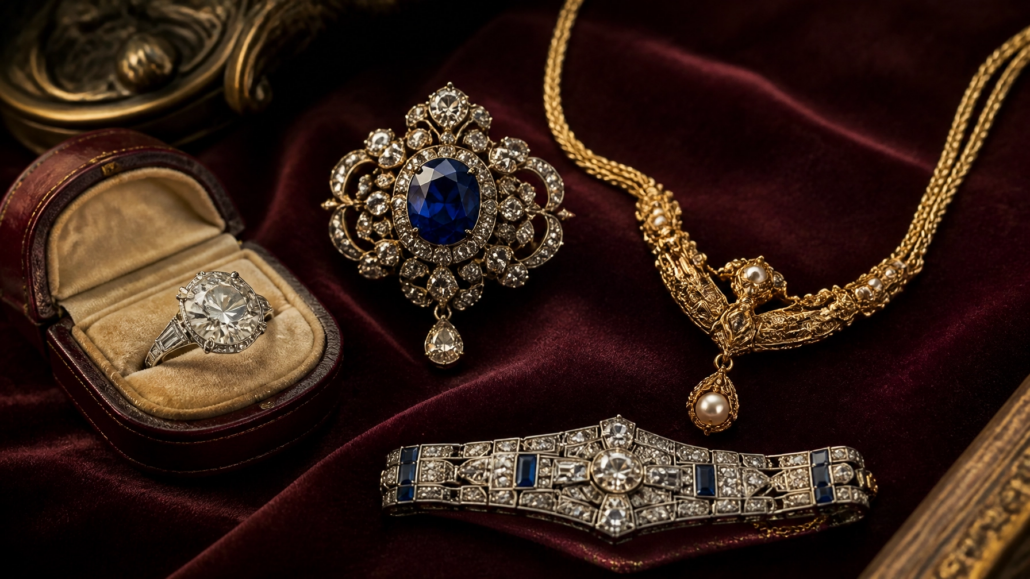
The Ultimate Guide to Rare Estate Jewelry: Everything You Need to Succeed as a Collector
1. Inventory Classification Systems
Collection of rare jewelry requires precise categorization. Professional standards differentiate items based on chronological age. Estate jewelry includes all previously owned pieces. This category is broad. Vintage jewelry must be older than 20 years but younger than 100 years. Antique jewelry must exceed 100 years of age. Identification of these categories is necessary for valuation.
Collectors in Knoxville, TN must verify age before acquisition. Blair House Antiques maintains a curated inventory of these classifications. Evaluation focuses on era, material, and origin.
2. Georgian Era Technical Specifications (1714–1837)
Georgian jewelry represents the earliest accessible category for private collectors. Production was manual. Mass production did not exist during this period.
2.1. Metal and Construction
- Metals: 18k or higher yellow gold and silver.
- Settings: Closed-back designs.
- Foiling: Metal foil was placed behind gemstones. This increased light reflection.
- Finish: Silver was often used for stone settings. Gold was used for the back of the piece.
2.2. Gemstone Data
- Diamond Cuts: Rose-cut and old mine cut.
- Common Stones: Garnets, topaz, and pearls.
- Structural Integrity: Georgian pieces are often fragile. Foiled backings are susceptible to water damage. Oxidation is common in silver components.

3. Victorian Era Specifications (1837–1901)
The Victorian era is categorized into three specific sub-periods. Each period has distinct technical markers.
3.1. Early Victorian: The Romantic Period (1837–1860)
Designs focused on sentimental motifs.
- Common Motifs: Hearts, bows, snakes, and birds.
- Materials: Seed pearls, gold filigree, and colorful gemstones.
- Item Types: Lockets and cameos.
3.2. Mid-Victorian: The Grand/Mourning Period (1860–1885)
Production shifted following the death of Prince Albert.
- Colors: Dominantly black.
- Materials: Jet, onyx, black enamel, and deep red garnets.
- Purpose: Memorialization of the deceased.
3.3. Late Victorian: The Aesthetic Period (1885–1901)
Designs became lighter.
- Influence: Japanese art and nature.
- Motifs: Insects, stars, and crescent moons.
- Materials: Lighter gold alloys and increased diamond usage.

4. Edwardian Era Specifications (1901–1915)
Edwardian jewelry emphasizes technical precision and the "white" look.
4.1. Material Advancements
- Platinum: Platinum became the primary metal for high-end jewelry. It allowed for thinner, stronger settings.
- Milgrain: Small beads of metal were applied to edges. This created a lace-like texture.
- Filigree: Fine metal wires were used to create intricate patterns.
4.2. Gemstone Selection
- Primary Stones: Diamonds and natural pearls.
- Accent Stones: Calibré-cut sapphires or emeralds were used sparingly to emphasize geometric lines.
5. Art Deco Era Specifications (1920–1935)
Art Deco jewelry is characterized by industrial influence and geometric regularity.
5.1. Design Principles
- Geometry: Use of circles, squares, and triangles.
- Contrast: Use of high-contrast colors. Example: White diamonds against black onyx.
- Symmetry: Pieces are strictly symmetrical along a central axis.
5.2. Technical Markers
- Metal: Platinum remained the standard until the early 1930s. White gold was introduced as a cost-effective alternative.
- Cut: Introduction of baguette and emerald cuts.
- Origins: Pieces often reflect archaeological discoveries from Egypt or the Far East.

6. Maintenance and Preservation Protocols
Antique and estate jewelry knoxville tn require specific maintenance routines. Failure to follow these steps leads to material degradation.
6.1. Cleaning Procedures
- Non-Invasive Cleaning: Use a soft, dry cloth for all pieces.
- Solution-Based Cleaning: Apply only to hard stones like diamonds, rubies, and sapphires. Mix lukewarm water with mild detergent. Use a soft-bristled brush.
- Restrictions: Do not submerge Georgian or foiled jewelry. Water will destroy the foil backing.
- Prohibitions: Avoid ultrasonic cleaners. These cause vibrations that loosen settings. Avoid steam cleaners. Thermal shock can crack emeralds and opals.
6.2. Storage Requirements
- Isolation: Store pieces individually. Hard gemstones like diamonds scratch softer metals and pearls.
- Environment: Maintain a dry, dark environment. Direct sunlight fades certain gemstones. Humidity causes metal tarnish.
- Organization: Use lined jewelry boxes or soft pouches.
6.3. Professional Inspection
- Frequency: Conduct an annual inspection.
- Checklist: Verify prong tightness. Inspect clasp functionality. Check for thinning of the band on rings.
- Location: Visit a specialized antique store knoxville tn for professional assessment.
7. Valuation and Authenticity Verification
Successful collection depends on accurate valuation. Several factors determine market price.
7.1. Rarity Factors
- Era: Georgian pieces are high-rarity. Art Deco pieces are high-demand.
- Provenance: Documented history of ownership increases value.
- Signatures: Designer marks (e.g., Cartier, Tiffany & Co.) provide a premium.
7.2. Physical Condition
- Originality: Replaced stones or modern modifications reduce value.
- Patina: Original surface oxidation on silver is often preferred by collectors.
- Wear: Minimal wear is acceptable. Significant damage to settings requires professional restoration.
8. Sourcing Estate Jewelry in Knoxville, TN
Blair House Antiques is the primary location for high-end vintage jewelry knoxville tn. The facility is located in a historic 1920s building.
8.1. Inventory Focus
- Estate Rings: Large selection of diamond and gemstone rings.
- Sterling Silver: Fine silver jewelry and holloware.
- Unique Items: Antique chandeliers and vintage collectibles.
8.2. Expert Curation
Collectors can access items that have undergone rigorous inspection. The staff provides technical data on each piece. This ensures authenticity for every acquisition.

9. System Status: Collection Initiation
Collectors must perform the following actions:
- Identify desired era (Georgian, Victorian, Edwardian, Art Deco).
- Establish a maintenance kit (soft cloths, mild detergent, individual pouches).
- Visit Blair House Antiques at 210 N Forest Park Blvd, Knoxville, TN 37919.
- Verify authenticity through expert consultation.
- Secure acquisitions in a controlled environment.
Inventory is subject to availability. Regular visitation is required for procurement of rare items.

